Cast of The Greatest Snowman. Photo credit @arabellaitani
Title: The Greatest Snowman
Style: immersive dining
Where: Pedley Street Station, Bethnal Green
To note: make them aware of food allergies, preferences etc.
3.5/5 stars
The Greatest Snowman is enormous – if slightly confusing – fun.
Played pretty much as a straight up pantomime, it come across as charmingly childlike and simple. The storyline is not taxing, and the immersive element was less prominent than in recent production by the same team Journey to the Underworld.
The food was just as delicious though. And what made this production considerably less child-friendly was the copiously flowing booze. Not that this reviewer is complaining about that! But it does make for a slight sense of dichotomy. This is a show I think my nephew and niece would enjoy, in an atmosphere I probably wouldn’t bring them to.
The scene is set by the conductor Doris (Ingrid Miller – whose performance owes more than a little to Su Pollard in Hi Di Hi) who welcomes us and flogs us Babysham (which is just as grim as you remember it being). There is then a battle for the spirit of Christmas embodied in the life and backstory of Mr Snow (Chris Heaney) – a human raised as the last of the snow people.
This is a silly romp and a highly enjoyable one. Much of your enjoyment does come from the others at your table as when the food is served the action is paused. We had a delightful bunch and were well looked after. No part of this experience is left much to chance.
Afterwards, we spent time in the lovely Christmas grotto themed bar – I highly recommend the gingerbread based cocktails.
Photo credit @arabellaitani
Overall this is a great, fun, lighthearted night out. The food is way above average and the ambience is a delight. Once again this is not theatre that will change your life, but it will give you a rollicking good time. Just watch out for the morning after!
Divine Proportions promises much and almost – almost – delivers.
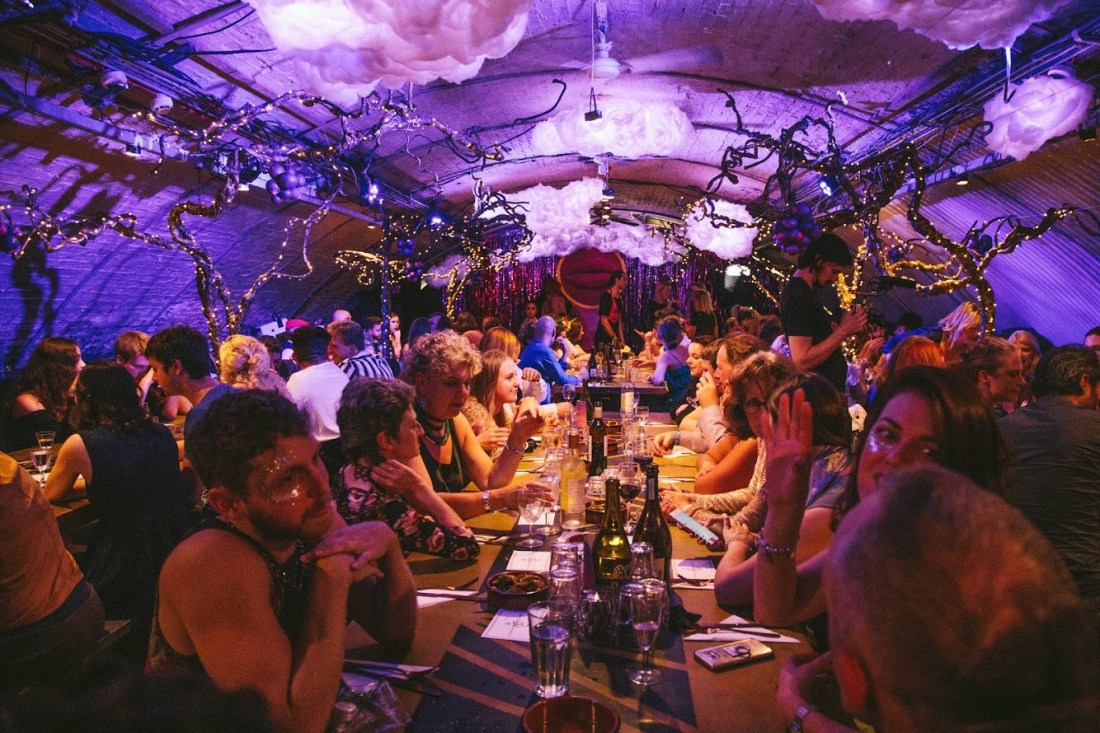
The party atmosphere is apparent from the beginning. Audience members are encouraged to dress decadently and buy further glitter on arrival.
Your intrepid author attempting to dress like a glamorous goddess…
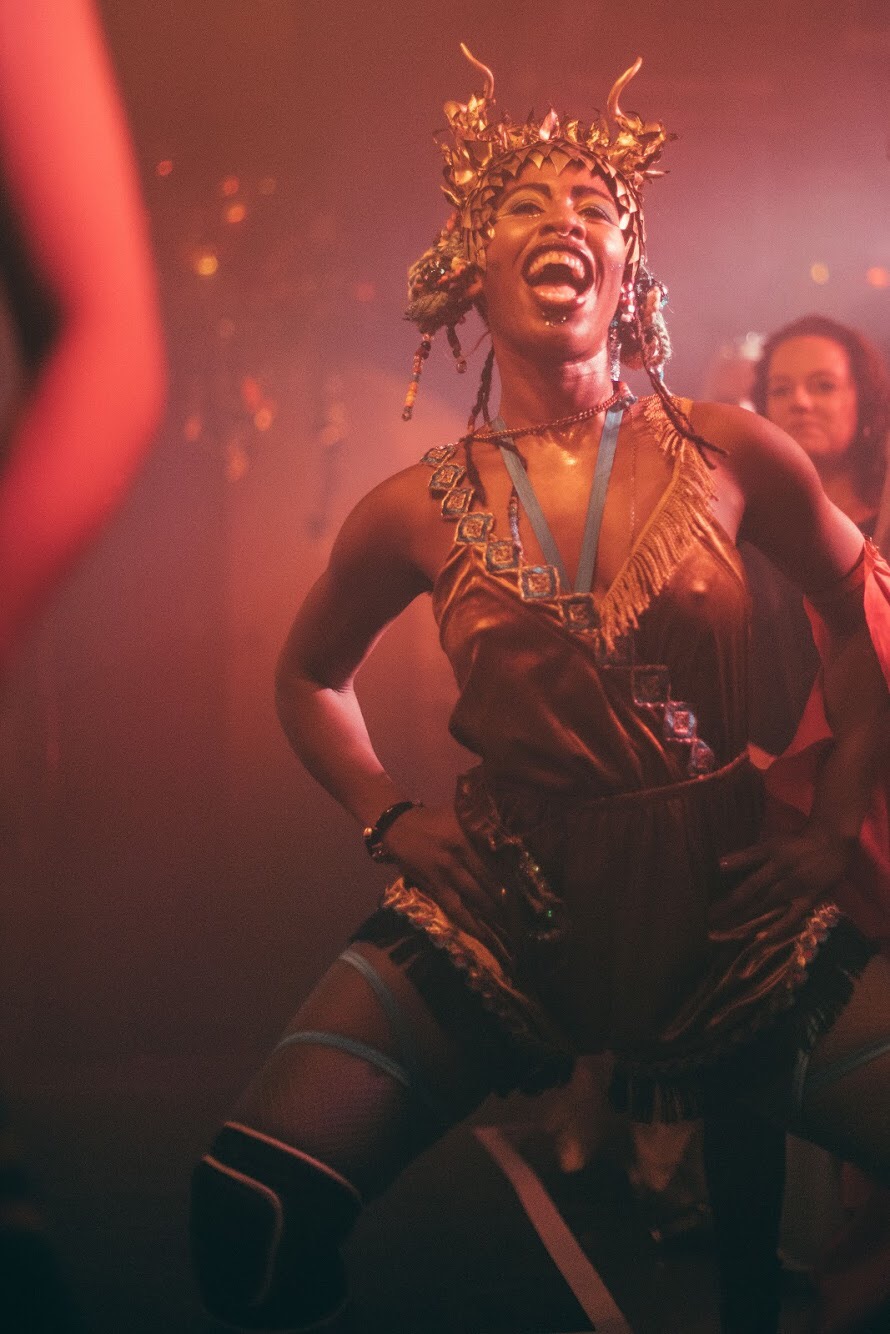
The music is classic hen night decadence and performed brilliantly in the downstairs bar by the cast who writhe with appropriate abandon. In fact, the downstairs bar action is by far the highlight of the show.
The problem with the main action is partly one of the venue and partly one of the production.
In terms of the venue, there is no sound amplification in the parts of the room furthest from the stage. Given the open inducement to get raucously drunk and the Saturday night crowd’s absolute willingness to do so (our party was no exception), we couldn’t really hear a lot of what was going on.
The venue was very full and as such the action on the night was very much dependent on who you were sat with or next to. I went with one other person and we were surrounded and somewhat overwhelmed by much larger groups. To avoid that, I would recommend smaller groups go during the week.
Divine Proportions had a pretty high innuendo threshold and there were some genuinely sexy moments to behold. The worshipfulness of the Maenads towards Dionysus was well played in particular. A slight bugbear of mine is that for a show all about the worship of all things flesh – all the flesh was very much female. No man-candy to behold. While most of the time an all-female cast would be held to be radical, and certainly Dionysus’s empowered sexuality was an exemplary performance of a woman – or even a goddess – at home in her own body. But to have an all-female cast at this kind of show felt almost reactionary. Women for looking at and encouraging the audience to eat drink and be very, very merry.
Divine Proportions is a fun night out. Not quite theatre, not quite burlesque, not quite vaudeville it is a decent meal with a floorshow you enjoy what you can catch of this. What I can’t tell is if it has pretensions to be more than that. if so, it should give those up and embrace its hen-night destiny.
Title: Frankenstein Style: Site-specific promenade Where: Sutton House, 2 – 4 Homerton High Street, Hackney, London, E9 6JQ When: Until 3rd November To Note: Mobility required – will climb stairs, dress warmly
Rating: 4/5
Frankenstein sets itself firmly in the 80s before the show begins with a thumping and iconic 80s soundtrack. As you enter the “squat” space and are greeted by a group with a very strong ‘Legs Akimbo‘ vibe telling ghost stories. As Mary speaks, she tells of a dream she had – a dream the group shared of a family suffering a tragedy.
As they tell it the story takes over and we are led through their interpretation of Frankenstein.
L-R: Justine (Katy Helps), Henry (Chris Dobson), Victor Frankenstein (Jeff Scott), Elizabeth (Jennifer Tyler_). Photo by John Wilson.
First my usual bugbear. This isn’t an immersive production despite being billed as such. Yes, the audience goes on separate journeys in the first half, but there is no interaction between us and the characters and no audience-led content.
What it is is site-specific. It makes excellent use of Sutton House as a venue, drawing both on its recent history as a squat and arts venue and it’s gothic grandeur as a space. It works to heighten the tension right down to having appropriately creaky wooden doors.
The story is a feminist twist on the classic Frankenstein story, strengthening the character of Justine (Kay Helps) to make her Victor’s equal rather than subordinate and making the monster a woman (Molly Small). The traditional loneliness of the monster is heightened by her desire to become a mother – to have someone to love and depend on her wholly. While This is an interesting approach that did make the women of the piece much more visible, I’m not sure how feminist it is to centre the female experience on motherhood. But the delivery – especially by Molly Small was so powerful that it worked.
Victor Frankenstein (Jeff Scott) and his monster (Molly Small) – photo by John Wilson.
The play uses a number of clever devices. The lighting, in particular, was exceptionally well designed not just to direct your mood, but to literally tell you what was happening. The switch from the spotlights of the action to the fairy lights of the interval literally lifted the mood. The music works to set different moods throughout and as mentioned, the use of the Sutton House space works very well.
I was less enthralled by the costumes and props which blended 1980s with early 1800s in a way that didn’t quite work for me. The show of Victor playing SEGA as he deteriorated and went into himself was well done in itself, but overall, it just confused to the point where it distracted from the drama.
Elizabeth (Jennifer Tyler) with ‘William’ – Phont by John Wilson.
A particular mention has to be made for the puppetry. Its inherent creepiness is well rewarded with a second half twist that was as brilliantly shocking as it was dramatic. Incredibly well played out, it set the scene for an incredibly affecting last 20 minutes that I found moving, disturbing and hard to shake off. If you’re anything like me, the challenge of the last 5 minutes will stay with you for some time and it is the strength of this ending that more than makes up for any pickiness I had earlier.
This is a disturbing, enlightening and properly gothic production. The ambience and atmosphere of Sutton House suits the drama perfectly and the cast delivers thoughtful scares throughout.
Dinner theatre is back and it’s gone immersive. This show – set in the main in a well-appointed train carriage journeying to hell – is great fun, if a little on the silly side.
The story is pretty basic – the train’s conductor is actually a long-lost lover of a woman kidnapped by the master of hell to be his bride. For a thousand years, he’s been seeking to rescue her and tonight could be the night. Simple Fairytale fare.
The same cannot be said for the food which was anything but simple. From the sumptuous butternut squash amuse bouche to the divine chocolate and honey dessert each course was sophisticated and delightful. It didn’t necessarily match the Hammer Horror production of the play, but the interplay worked surprisingly well. I wasn’t drinking, but I was also told by companions that the cocktails were seriously up to scratch too.
Combining theatre with food has always been a tricky business (my favourite depiction will always remain Kevin Kline’s bravura performance in the much underrated Soapdish – churning out Death of a Salesman as the elderly complain about their chicken). Immersive theatre is a great answer to this. Of course the audience are noisy and rowdy – eating and drinking with abandon. They’re supposed to be – that’s part of the production.
So the cast running around serving our food, clearing our plates and keeping the story ticking along to be timed with the food (exceptionally well done here) seemed just natural. But making immersive theatre – especially a play about travelling to the underworld on a first class train – seem normal takes a great deal of skill. Claude the Conductor and his assistant Gordy did just that.
This is not the kind of immersive theatre that will challenge your inner being. It didn’t change my perspective on life and death, love or burlesque. But it was a rollicking night out. Sometimes that’s the real key.
Title: Accomplice New York Style: Immersive theatre meets treasure hunt Where: Downtown Manhatten When: Until October To Note: Mobility required, alcohol and food included
Rating: 4/5
How to enjoy theatre, keep fit and see parts of Manhatten you might not otherwise experience! Accomplice is a fun, problem-solving experience which will give you your 10,000 steps all over Downtown.
You won’t receive the address until the day before you arrive and you won’t end up in the same place as you start. Along the way, you’ll be guided by a series of characters some more eccentric than others. You’ll also interact with real-life New Yorkers who will give you instructions along the way too.
You’re well guided through the experience. While your group will spend a lot of time alone walking between scenes and working out puzzles, the actors do pretty well at keeping your experience on the rails. Because of the alone time, your experience will be somewhat dependent on your group – throw an arsehole into the mix and it could be a considerably less fun experience.
Luckily my gang were lovely. We worked well together solving clues and following maps. We got a bit confused and tried to open a number of doors we had no right to access – but overall, we Worked well on the puzzles and found them just the right level of challenging and fun.
This game isn’t for everyone. You’ll be walking through crowded spaces and sometimes covering quite long distances. But for those who Can take the walking and crowds, this is a really enjoyable way to see the Lower East Side.
Title: Illicit Secrets: Bletchley Style: WW2 Codebreaking drama based on real people Where: Colab Factory, 74 Long Lane, London SE1 4AU When: 8.00 pm until 28th August To Note: Mobility needed to get around the rooms
Rating: 4.5/5
Another World War Win at the Colab Factory.
Illicit Secrets: Bletchley is a very clever drama. Like a predecessor Hidden Figures, it uses immersive theatre to celebrate real heroes from The Second World War – in this case, the code breakers of Bletchley Park. It does this by immersing you in their work and their world.
Tom Black as Gordon Welchman and Gabriel Burns as Keith Batey
The drama happens on three levels. Firstly, the code breaking. Every member of the audience is involved in decrypting fiendish cyphers. These are tough. Genuinely challenging and you aren’t spoon fed at all. It took us a significant portion of the evening to get anywhere, but when we did, it was seriously satisfying.
The second is the interpersonal relationships between the staff at Bletchley. Some aspects of these are more known to a modern audience than others. The story of Alan Turing is well known now, and the balance between the need to treat his situation with modern sensitivity and the need to remain true to the drama is deftly handled. Equally important are the other characters who may not be as well known but who all contributed to winning the war.
Timothy Styles as Alan Turing
The final layer is the internal spy game, with Whitehall spying on Bletchley Park to discover what could constitute a security risk. It was through this mechanism that the story is both moved on and resolved.
While Illicit Secrets: Bletchley is run by a different company than Colab Factory’s previous success For King and Country, its fair to say there’s a reasonable amount of crossover. In fact, Director Christopher Styles previously starred in FKAC. This is a team that love and respect WWII drama, who aren’t mawkish by are equally unafraid of sentimentality.
L-R Beth Jay as Mavis Lever, David Alwyn as Dilly Knox, Amelia Stephenson as Joan Clarke
But don’t worry if you’re not a war buff. I’m certainly not. But the drama stands apart from the period and keeps the interest. The key events they refer to are well known enough that you don’t have to be a historian to appreciate them, though I am sure there were all sorts of lovely details thrown in to please those who’d appreciate them.
Illicit Secrets: Bletchley was fun, thought-provoking and challenging. The codebreaking made my brain hurt in a good way. The ending left me moved. The acting was exemplary. It’s not on for long, but if you get a chance – see it.
Owen Kingston looks like a pirate king. Even in a small coffee shop dashing between engagements, he looks larger than life and like he should be brandishing a cutlass (very unfair, given he is incredibly sweet natured).
Owen Kingston as Captain Alan Howard in For King and Country
He’s been a theatre director for 20 years, and doing immersive theatre for the last five. He went to see The Drowned Man, and it changed everything for him. “it made me think completely differently about everything I had done up to that point. All I wanted to go was create that kind of work, that had that kind of audience experience built into it.”
For King and Country is due to close at the end of the Summer, but has been an extraordinary success. It took Owen months trying to get the project right before he was even willing to talk to anyone else about it. For four weeks at least the idea existed only in his head and after that, it was a couple of weeks of technical work before he was ready to take it to other people, rehearse and block it out.
Owen has a company he knows and trusts implicitly. He has built this up over time and adds to it with each production. He brings on new people but finds it easier to work with the same expanding group repeatedly. “For my own sanity I’d prefer it if the cast as most people I’ve worked with because I have a shorthand with them already and it makes it less laborious.”
This isn’t down to cliquishness, but to the very specific type of work that Owen creates. King and Country, for example, isn’t just immersive, it’s entirely audience-led. The actors can never expect to get fully onto a set of rails. They have to be facilitators as much as they are entertainers and that’s a very specific skill set. “You want actors who are really sensitive to the audience members they’re with and are able to tailor what they’re doing accordingly. And who can instinctively read a room and know where to go for different things.”
Trust is particularly important in immersive theatre. “In the sort of theatre we do vulnerability as is massively important. And it’s nearly impossible to be vulnerable with somebody you don’t trust.”
Audiences Are Paramont
This is part of why Owen is very protective of his cast and very aware of the need to be a good employer. Both in terms of the staff’s welfare and the need for them to be able to perform and deliver. Staff are actively encouraged to take time off for both physical and crucially mental health issues.
“We have a rule if they’re having serious issues in their personal life, if they’re not they’re not feeling mentally fit, we would treat that seriously as if they had the flu. We’re not going to let them on if they’re vomiting into a bucket. Similarly, we’re not going to let them go on if they have just broken up with their long-term partner and they’re in a total mess.
I think it’s so important because audiences experience for any theatre company has to be paramount. And if your audience experience can be harmed by anything, you have to take that seriously as a risk and in a West End musical your audience experience is unlikely to be harmed by an actor’s personal life unless the actor can’t do the show for whatever reason. In an immersive theatre show, where the actor is responding dynamically to what the audience say to them, it’s really easy for that to get out of control if their emotional state not in control.”
Emma Burnell with the cast of For King and Country, London (soon to be turned into a game)
New Breed of Video Game
When I ask Owen what’s next for him and Parabolic, the answer is not at all what I expected. For King and Country is getting made into a computer game. As those who have read about my dream shows, you can see me getting my geek on right here. Owen says “It will be a whole new breed of video game which is where you converse with the characters in the game. For certain core things it dynamically generates the speech that comes back to you, so it intelligently responds to what you say, it remembers what you say so that it can bring it up again later.”
The gameplay won’t exactly match the experience of the play. It has to be developed so a player will return again and again. But that opens up an exciting possibility. “There were some things we can do way better So one thing it can do is make calls to other sites on the Internet to plug information in. So it can literally go to Wikipedia and look something up and then use it virtually instantaneously.”
Also in the planning stage is a second show – a direct sequel to For King and Country. Set four years after the original, it would feature the same characters, on an alternative D-Day. They and the audience will become leaders of the British resistance, breaking into the same bunker and fighting once again For King and Country. Owen says it’s not “nailed on” But you get the sense, from his excitement and confidence, that if he can find a way to do it, it will happen.
Owen Kingston
There are other, less developed, plans. Plans that need a bigger site or just a different type of building. That’s not easy to find for the right cost, in the right place in Central London. But Owen Kingston is a man who makes things happen. As we wrap up, his delight in every detail of his work is what stays with me most clearly. The care he takes over audiences and actors are replicated in the attention he pays to plot and atmosphere.
Whether it be in a game, a giant warehouse or back in the bunker, there will be that magic. “It has to feel magical,” Says Owen, “otherwise, what’s the point?”
When I meet up with Daniel Thompson of BROKENSTEREO, it is in a slightly incongruous setting. Our talk is of fantasy worlds, a never-ending circus and the joy of escapism. But we’re sat in a quintessential ‘old man’s pub’ in the East End, surrounded by England bunting in the middle of World Cup fever.
Daniel Thompson, Artistic Director of BROKENSTEREO
Daniel himself doesn’t wholly look the part either. He’s dressed in a smart grey shirt and the smart/casual trousers that have become the uniform of most working men over this long, hot summer. When he talks of his Hampshire upbringing, it’s also clear that part of him longs to still be a country boy – a long way away from designing fiendish games to be played in derelict houses in Peckham.
Excursive Theatre
But there is something impish about him, and it is this quality that shines through when he talks about BROKENSTEREO, and the work he describes as ‘excursive theatre’. I ask him what he means by this. “It’s a breakdown of the words. An excursion is a trip, a journey, something exciting. Excursive language is talking in lots of different narrative parts, and always deviating and going in different ways… In the end, it will be a blend of immersive theatre, escape room and theatre gaming.”
Daniel is a born trickster, which is why the gaming element of the work he produces is so strong. He sees this trickery as a quintessential part of immersive theatre “you’re playing with people, you want to trick them to believe something that isn’t quite real. I think you’ve got to be impish enough to convince people that something is real and then turn around and go “kidding!””.
Brought up on logic problems as I was, we both agree that this gaming element is key to the success of the work he’s produced so far. Recent work Phase Three relied heavily on logic-based games to get to the end of the work. It is this combination of dedication to logic and pranksterism that makes Daniel’s work so much fun.
A Different Form, A Different Theme, A Different Story
Immersive theatre is often about escapism, and BROKENSTEREO has created a whole other world, known as The Realm, that their shows allow you to escape into. Phase Three was the introduction to this world, but Daniel has plans to extend it over the coming year, with an anthology of pop-up shows running throughout the year. This will remain in experimental form, and every time you engage with the Realm it will be something slightly different. As Daniel says “A different form, a different theme, a different story. And then, at the end of the year, there’ll be a revelation to the audience.”
Eventually, the hope is that these smaller pop-ups will coalesce into a much bigger whole, where they can take on a whole building and audiences will “not only go into the Realm as it exists, but also backstage, if you will, of the Realm.”
Publicity Still from Phase Three
This sense of worlds within worlds is clearly a fascination for Thompson. He describes his introduction to the world of theatre as a moment when – in a school drama class – hw was asked to imagine whole new worlds. “I just remember that moment being incredible. Like nothing is here, just imagination. And by telling stories I felt completely transported.”
To and With the Audience
It is both Thomspon’s love of escapism and his desire to ‘show the workings’ that drives him. But he is also totally customer focused – an essential quality in immersive – or excursive – work. He credits this to his day job of running bars for West End theatres. “Everything I do in my day job is customer experience and how you develop that and create it and make something really exciting and good and perfect. I think that’s what you have to start thinking what you can do to and with people.”
Thompson says his ‘dream’ project would be a “massive circus type thing – blending circus and magic is something really beautiful.” This project would include spaces for new and emerging performers to develop skills and acts as well – inevitably – as off stage games to test the mind. But it would sit alongside an ongoing, living breathing world created around the circus space.
I don’t know if this is fundable or even realisable, but it is certainly true to say that the ambition BROKENSTEREO and Thompson has deserves ever bigger stages, ever more ambitious canvasses. As we leave the pub – ironically for Daniel to rush off to serve drinks to theatre punters, it has become clear that it is that combination of vision, ambition and artful impishness that is the charm of immersive theatre and of the work Thompson is doing within the medium.
Title: The Feelgood Institute Style: A collection of immersive and multisensory experiences Where: 183-185 Union Street, London SE1 0LN When: 12–7pm, Wednesday–Sunday, 8th June–1st July To Note: Will need to climb stairs. Some installations use flashing lights
Rating: 3/5
The Feelgood Institute really lives up to its name. While in terms of production values, as theatre it’s a little cheap and cheerful (we were literally building things from rubbish at one point), the commitment to character and the experience were just as present as they are in bigger, glitzier shows.
The installations included a tribute to the glory days of acid house, an incredibly chilled light installation and a strange fountain where they gave me wormwood to drink. Note to self – wormwood is disgusting.
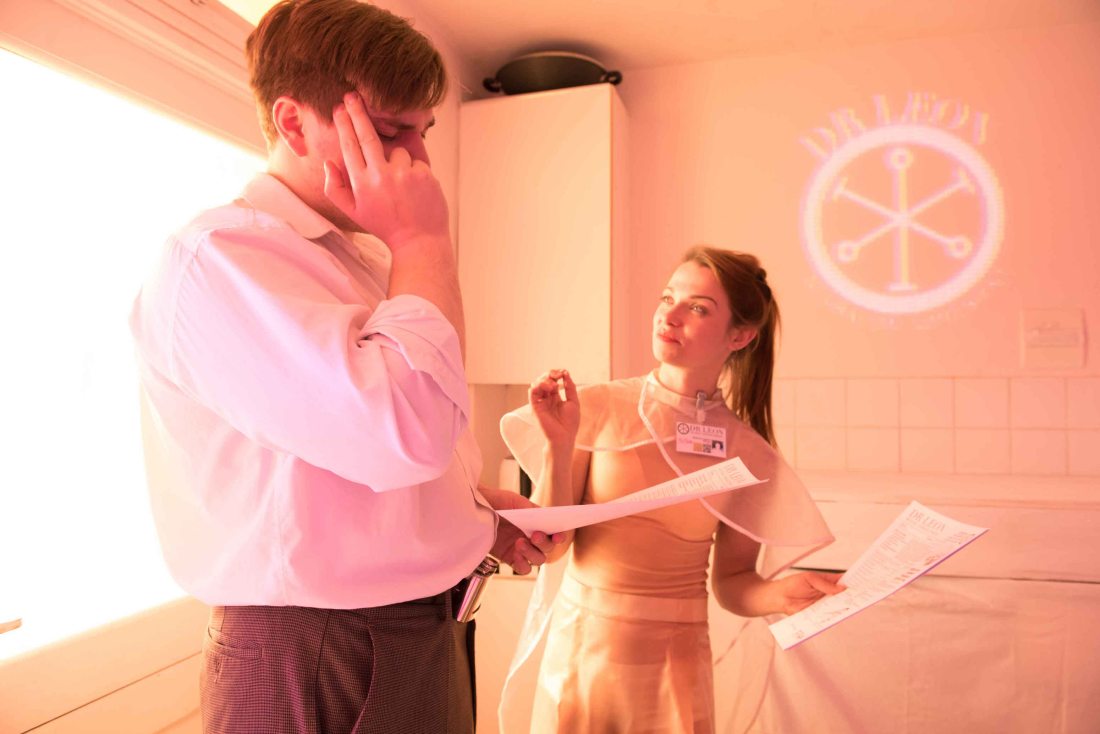
The two key immersive pieces were Dr Leon: Neural Enhancement and The Society of Nice.
The former consists of being taken through a mock surgery, from waiting-room form-filling, to being strapped to a chair, to the aftercare. The idea is that they are implanting a chip in your brain to either improve your love, power or knowledge. I went for power – don’t laugh!
Of course, you know it’s all a bit of play-acting, but there were some interesting neuro-linguistic programming techniques as well as a good dollop of mindfulness involved, so despite the fact there’s nothing new in my brain, I did come out of the experience feeling not just good, but “Better”.
The second immersive experience was the Society of Nice. A bizarre cross between immersive theatre and playgroup, this experience was, well, nice. Fuelled largely by puns and silliness, the performers kept the conceit going nicely despite a set literally made from cardboard boxes and hats.
The Society inducts each participant as a new Agent of Nice, and the general aim again seemed quite mindful. Once we were fully inducted and signed on, we made a wish for ourselves and set it free into the world, while at the same time being given a nice mission to complete.
Neither of these were installations that were going to shatter anyone’s world. They didn’t give me the goosebumps of a Gatsby or Then She Fell or challenge me like For King and Country. But they were a bloody nice way to spend a Sunday afternoon. And you can’t say fairer than that.
Title: Dead Quiet Style: Immersive theatre, Noir Where: Kensington Central Library, 12 Phillimore Walk, London W8 7RX When: Saturdays at 1.45 until 13th October 2018. To Note: Will need to climb stairs. Some running, some darkness.
Rating: 3.5/5
Upon arrival at Kensington Central Library, you’re greeted by librarian Gwendolyn Radcliffe (Gilly Daniels). Retired now, she tells you she’s worked there for over 40 years and is still troubled by a long-forgotten crime that took place one night in 1962.
At Dead Quiet, you’re thrown into the action immediately – while still in the working part of the library. God alone knows what the ordinary punters quietly checking out books and CDs thought of our talk of long forgotten cold war intrigue between the US, Cuba, USSR and the UK, never mind the spiritual investigator Jack Daw (Ben Hale).
Eventually, we are taken to the basement of the library – not a place the public regularly see. The only problem we had with this was the excitement of some of the more local participants at wanting to explore the space rather than the plot. We were told of an unexplained death the night of a music festival in 1962 and the ghost that has haunted the library ever since.
Gerardo Cabal as Hector and Neil Summerville as ‘The Shabby Man’
Dead Quiet is unusual for an immersive piece as it happens in three acts and two semi-intervals. Divided into investigatory groups, in act one, each individual within the group is assigned a different character to follow, in act two, the group investigate together and in act three there is the denouement.
In between the investigatory acts, the groups came back together to swap notes, theories and anything else they have learned along the way. Who is an agent of whom? Who is working with whom?
The show is tightly plotted. With everyone following different characters in the first act, and the audience improvising their interrogation in the second, the actors do extremely well to both stay in character but also to remember just how much they have revealed to whom. The individual plots weave in and out of each other seamlessly to create an incredibly engaging and coherent whole.
Kensington Central Library is a great place to set this drama and production company ImmerCity have done well from this partnership. Just rabbit warren enough to add to the sense of intrigue and just brave enough to let the audience wander around in the semi-darkness, the staging was as tight as the scripting.
Gerardo Cabal as Hector and Monica Nash as ‘The Model’
For those readers who haven’t met me before, this may be the moment to let you know I have a *slight* tendency to be a bit bossy and take-charge (my friends are now weeping with laughter at the *slight*). That was indulged to an extent by my fellow participants (I just give off an aura!) and they let me lead some of the interrogations. But we all got a reasonable crack of the whip and a good time seemed to be had by all.
A crack investigative team is only ever as strong as its weakest member and on this occasion that was most definitely me. My guesswork was a long way off – though one of my fellow participants got the ending spot on.
If I have a quibble at all with Dead Quiet it is with the third act denouement. For the first two acts, Gwendolyn and Jack are there to guide us through the drama and help us to reach our conclusions about what has happened.
But at the end, this is Gwendolyn’s tale. And it is her that takes us through the “Poirot” moment, unmasking the killer and revealing the plot.
I would have prefered for the audience to have been forced to make a decision about who the killer was before it was revealed. Even if – like me – we got it completely wrong. It was just a slightly less immersive end to what had up to that point been a spot-on experience.
But that is a minor note, not a major flaw. Dead Quiet was a genuinely fun and enjoyable way to spend my Saturday afternoon. It’s noir atmosphere and complex storyline kept me enthralled throughout.
Dead Quiet is showing at the Kensington Central Library until October 13th. Click here for more information.





 So the cast running around serving our food, clearing our plates and keeping the story ticking along to be timed with the food (exceptionally well done here) seemed just natural. But making immersive theatre – especially a play about travelling to the underworld on a first class train – seem normal takes a great deal of skill. Claude the Conductor and his assistant Gordy did just that.







 Soaked in Dreams